
ATHLETICS
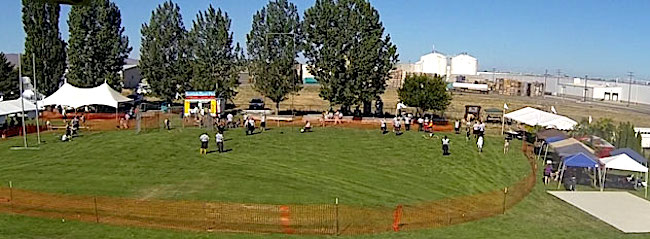
Highland heavy athletics has been a big part of the day's activities since the first Prosser Scottish Fest and Highland Games in 2001.
Online registration and payment for 2026 is now available! Online Athletics Registration
Email the Athletics Chair (athletics@prosserscottishfest.org) for information on 2026 events.
Online registration and payment for 2026 is now available! Online Athletics Registration
Email the Athletics Chair (athletics@prosserscottishfest.org) for information on 2026 events.
THROWING EVENTS
Clachneart Stone
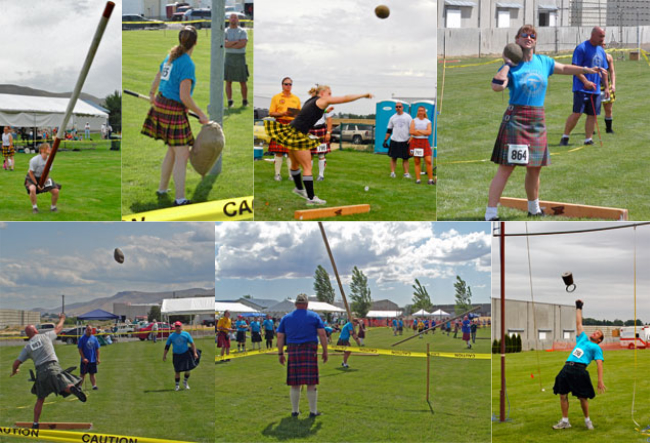
Throw a round stone for distance with a running approach, Measured from point of trig where put is made to nearest break of the ground. This event reflects a common practice by early Highland Chieftains who kept a large stone to challenge the visiting clan's warriors throwing strength. Best of three attempts scored.
Weight for Distance
Weights are common box weights, attached to a ring handle by chain; the overall length is 18 inches. Athletes are allowed a nine-foot run up (most spin similar to a discus-thrower), must use only one hand to throw, and have to remain behind the trig. Women throw 14 lb and 28 lb weights; men throw 28, 42 (Masters) and 56 lb weights. Best of three attempts to the nearest ground break scored.
Hammer
The original Scots hammer may have been that used by granite quarrymen. In America, it was the heavy, long- handled blacksmith's hammer. Modern hammers feature an iron ball fitted on a long, flexible shaft. The shaft is gripped by the athlete and swung around in two or three complete turns, then hurled through the air. Overall hammer length is 50”. Men throw 16 lbs; women throw 12 lbs. Best of three throws to the nearest ground break scored.
TOSSING EVENTS
Weight for Height
Athletes toss a weight up and over a crossbar using only one hand. The event is believed to have begun as a training method for tossing the grappling hooks used for scaling tall fortifications. Athletes may choose the height to enter the competition then must compete each time the bar is raised. Women throw 28 lb, men throw the 42 (masters) and 56 lb weights. Best of three attempts scored at each height.
Sheaf Toss
A sheaf (burlap bag filled with hay) weighing 16 or 20 pounds is thrown over a crossbar with a pitchfork. The sheaf toss has roots on the farms of Scotland. Using pitchforks, young men would attempt to pitch wheat to the storage loft on the barn's second floor. Best of three attempts scored at each height. Women toss 10 lbs.
CABER TURN
This is probably the most famous of the Heavy events dating from the 16th Century where it may have begun as a military tactic used to breach barriers or bridge rivers. Athletes attempt to turn the caber (80 - 120 lb delimbed tree), end-over-end by holding it upright against the shoulder, running a short distance, and thrusting it up and over. The goal is to make the narrow end (the one the athlete holds) flip over the wider end. In a perfect turn, the wide end of the caber lands, not bounces to the ground, and the pole falls directly away from the athlete in a “12 o'clock” position. Deductions occur based on the number of degrees away from the perfect 12 o'clock mark. Athletes may take any length run they wish and toss from where they choose. All successful turns of three attempts are scored to determine the winner. Men turn 15' and women 12' cabers.
Clachneart Stone
Throw a round stone for distance with a running approach, Measured from point of trig where put is made to nearest break of the ground. This event reflects a common practice by early Highland Chieftains who kept a large stone to challenge the visiting clan's warriors throwing strength. Best of three attempts scored.
Weight for Distance
Weights are common box weights, attached to a ring handle by chain; the overall length is 18 inches. Athletes are allowed a nine-foot run up (most spin similar to a discus-thrower), must use only one hand to throw, and have to remain behind the trig. Women throw 14 lb and 28 lb weights; men throw 28, 42 (Masters) and 56 lb weights. Best of three attempts to the nearest ground break scored.
Hammer
The original Scots hammer may have been that used by granite quarrymen. In America, it was the heavy, long- handled blacksmith's hammer. Modern hammers feature an iron ball fitted on a long, flexible shaft. The shaft is gripped by the athlete and swung around in two or three complete turns, then hurled through the air. Overall hammer length is 50”. Men throw 16 lbs; women throw 12 lbs. Best of three throws to the nearest ground break scored.
TOSSING EVENTS
Weight for Height
Athletes toss a weight up and over a crossbar using only one hand. The event is believed to have begun as a training method for tossing the grappling hooks used for scaling tall fortifications. Athletes may choose the height to enter the competition then must compete each time the bar is raised. Women throw 28 lb, men throw the 42 (masters) and 56 lb weights. Best of three attempts scored at each height.
Sheaf Toss
A sheaf (burlap bag filled with hay) weighing 16 or 20 pounds is thrown over a crossbar with a pitchfork. The sheaf toss has roots on the farms of Scotland. Using pitchforks, young men would attempt to pitch wheat to the storage loft on the barn's second floor. Best of three attempts scored at each height. Women toss 10 lbs.
CABER TURN
This is probably the most famous of the Heavy events dating from the 16th Century where it may have begun as a military tactic used to breach barriers or bridge rivers. Athletes attempt to turn the caber (80 - 120 lb delimbed tree), end-over-end by holding it upright against the shoulder, running a short distance, and thrusting it up and over. The goal is to make the narrow end (the one the athlete holds) flip over the wider end. In a perfect turn, the wide end of the caber lands, not bounces to the ground, and the pole falls directly away from the athlete in a “12 o'clock” position. Deductions occur based on the number of degrees away from the perfect 12 o'clock mark. Athletes may take any length run they wish and toss from where they choose. All successful turns of three attempts are scored to determine the winner. Men turn 15' and women 12' cabers.
Highland Heavy Athletics Records
See the North American Scottish Games Athletics database for 2024 results and other results throughout the years.
From the NASGA website Database page and Results panel:
Select Year (top center of Results panel);
Select Games (use drop-down menu and click on "Prosser Highland Games" under "June");
Once Prosser Highland Games is selected, click on "Select."
See the North American Scottish Games Athletics database for 2024 results and other results throughout the years.
From the NASGA website Database page and Results panel:
Select Year (top center of Results panel);
Select Games (use drop-down menu and click on "Prosser Highland Games" under "June");
Once Prosser Highland Games is selected, click on "Select."


Updated 05/07/2026 | © 2001-2026 Prosser Scottish Fest | Site Design by David Lanigan | Contact Webmaster